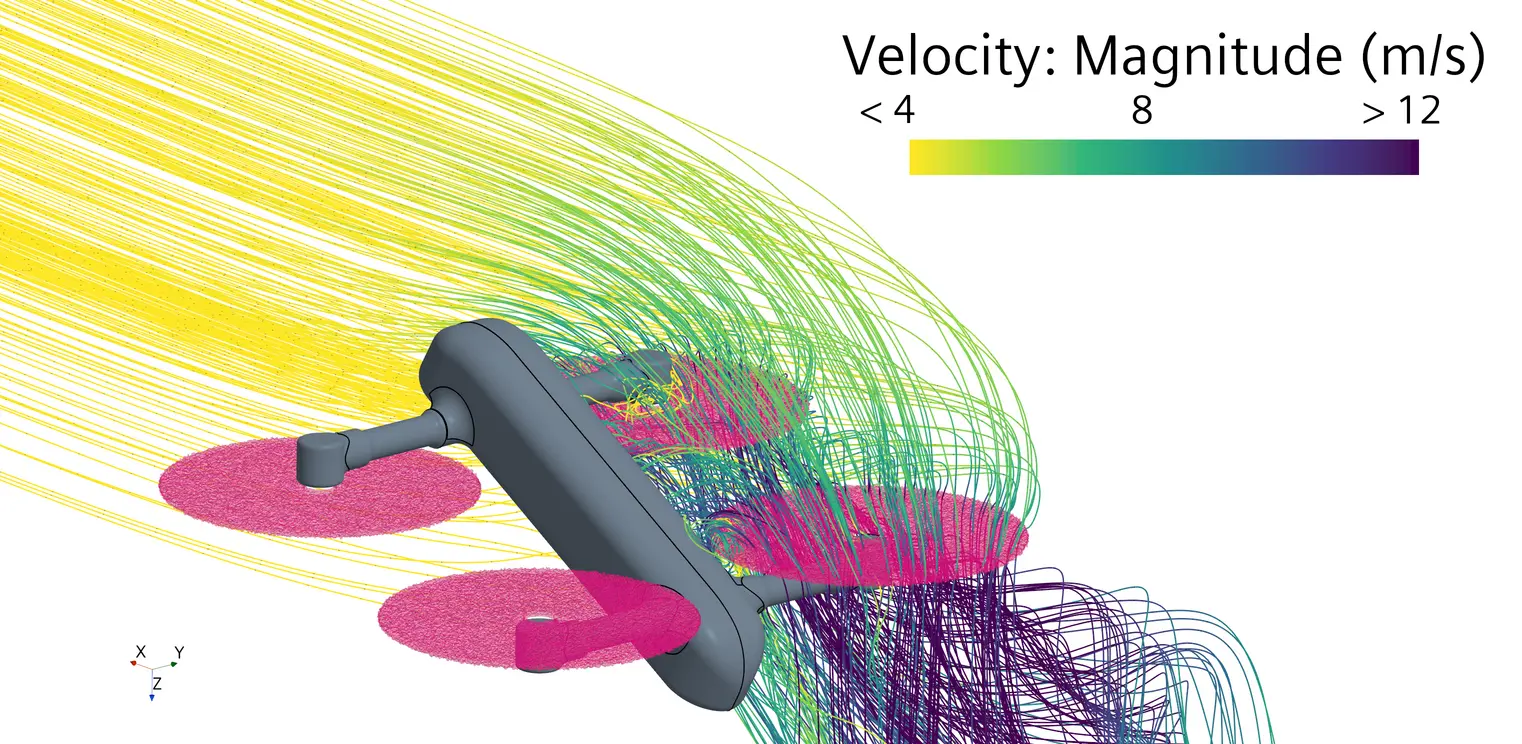
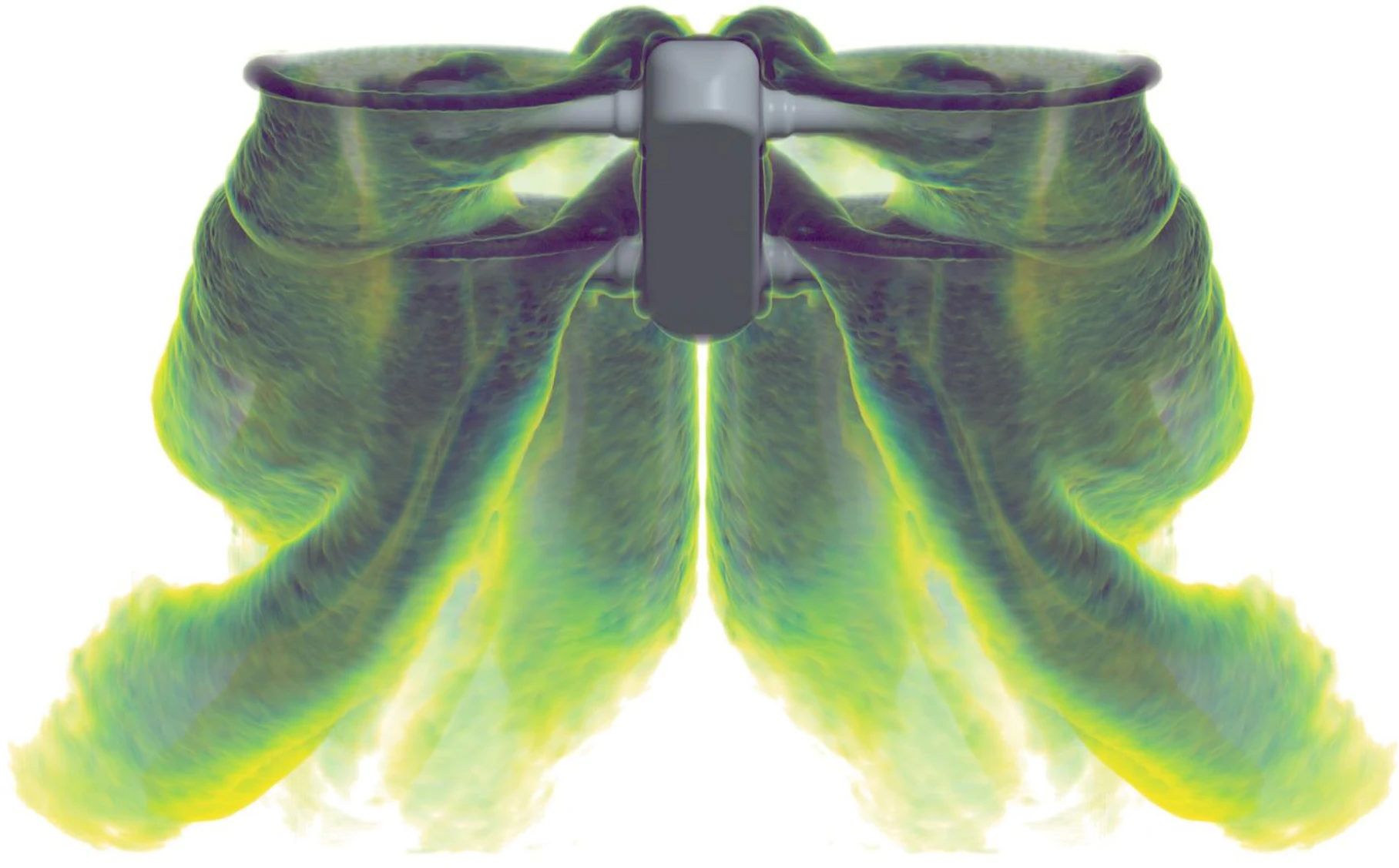
While fixed, unactuated rotor tilt is increasingly utilised in commercial multi-rotor unmanned aerial vehicles (UAV), its impact on forward flight performance remains poorly documented in the literature. The current work addresses this gap in the literature by systematically quantifying the performance trade-offs of rotor tilt across various airspeeds. Furthermore, a novel rotor configuration is proposed to mitigate some of the tilted rotor configuration’s inherent drawbacks. The different configurations are evaluated using a computationally affordable numerical approach that combines steady-state computational fluid dynamics (CFD) simulations, a simple proportional–integral (P–I) trimming algorithm, and actuator disk rotor modelling (ADM). The findings reveal that the aircraft’s power requirements can be reduced by more than 29% for airspeeds greater than 20 m/s, while its range can be increased by up to 22% with the alternative rotor configurations. However, the modifications were found to have a significantly lesser impact on endurance, as only a 2.9% increase is noted at best.
@article{drones10020105,author={Mullen, Brendan H. P. and Varela Martínez, Pau and García-Tíscar, Jorge and García-Cuevas, Luis Miguel},title={Numerical Analysis on the Influence of Rotor Configuration on Quad-Rotor Unmanned Aerial Vehicle Flight Performance},journal={Drones},volume={10},year={2026},number={2},article-number={105},issn={2504-446X},doi={10.3390/drones10020105},}
Conference
Analytical Prediction of Propeller Thrust for Lift-Plus-Cruise Tilt-Rotor Configurations with Wind Tunnel Validation
Néstor
Alcañiz-Brull, Pau
Varela, Jorge
García-Tíscar, and Luis Miguel
García-Cuevas
Continuous population growth will lead to further expansion and densification of urban environments. In this context, Urban Air Mobility (UAM) has emerged as a new transportation solution through the use of Vertical Take-Off and Landing (VTOL) aircraft, more precisely, configurations such as lift-plus-cruise tilt-rotors. During the conceptual design phase, propeller design methodologies commonly reported in the literature rely on vortex-based approaches or actuator disk theory. However, the accuracy of these methods strongly depends on the inflow angle and operating conditions. This paper introduces an analytical model to predict propeller thrust at a 90° inflow angle (edgewise flight), based on a correction of the thrust under axial flight conditions and the propeller geometry evaluated at 75% span. The approach relies on local velocity and angle of attack estimations derived from classical Blade Element Momentum Theory (BEMT) with an additional correction to account for stall effects at high angles of attack. This capability is particularly relevant for modeling lift-plus-cruise tilt-rotor configurations cruise phase during early design stages while maintaining minimal computational cost. The proposed model is validated against wind tunnel measurements for several propellers tested at different global pitch angles, varying from 0 m/s to 9.1 m/s of windspeed and 1300 to 6200 rpms, demonstrating the applicability of the developed formulation for blades with twist angles up to 16°.
@article{engproc2026142003,author={Alcañiz-Brull, Néstor and Varela, Pau and García-Tíscar, Jorge and García-Cuevas, Luis Miguel},title={Analytical Prediction of Propeller Thrust for Lift-Plus-Cruise Tilt-Rotor Configurations with Wind Tunnel Validation},journal={Engineering Proceedings},volume={142},year={2026},number={1},article-number={3},issn={2673-4591},doi={10.3390/engproc2026142003},}
Journal
Numerical analysis of quad-rotor aerodynamic and aeroacoustic performance with automated trimming algorithm
L.M.
García-Cuevas, J.
García-Tíscar, P.
Varela, and B.
Mullen
The current work introduces a novel and affordable Computational Fluid Dynamics (CFD) methodology for the purpose of assessing the aerodynamic and aero-acoustic performance of multi-rotor systems under trimmed flight conditions. The approach couples a simple Proportional-Integral (P-I) based trim algorithm and steady state CFD solver to automate the process of determining the set of control variables that results in balanced flight conditions. The methodology’s low computational cost is primarily achieved by including the rotors’ effects on the flow field with actuator models. A partial validation of the rotor modeling approach in isolated hover conditions reveals slight discrepancies in the computed aerodynamic loads but good agreement with experimental results in terms of the prediction of tonal noise. The CFD procedure is subsequently applied to evaluate a quad-rotor Unmanned Aerial Vehicle’s (UAV) performance in varied flight scenarios. The obtained results demonstrate that this automated approach effectively predicts quad-rotor performance trends, aligning with previously published data. Key findings include the fact that a hybrid over-mounted fore rotor and under-mounted aft rotor configuration negatively affects forward flight performance, and that the airframe’s geometry and distribution around the Center of Gravity can have a significant impact on flight characteristics. Finally, comparisons between the automated trim procedure and manually imposed trim parameters in transient aero-acoustic simulations reveal a more accurate approximation of trim when using the automated method. The comparison additionally highlights the importance of simulating multi-rotor systems in physically representative flight conditions as notable differences in the UAV’s acoustic footprint are observed between cases.
@article{GARCIACUEVAS2026113560,title={Numerical analysis of quad-rotor aerodynamic and aeroacoustic performance with automated trimming algorithm},journal={Aerospace Science and Technology},volume={179},pages={113560},year={2026},issn={1270-9638},doi={10.1016/j.ast.2026.113560},author={García-Cuevas, L.M. and García-Tíscar, J. and Varela, P. and Mullen, B.},keywords={UAV, Multi-rotor, CFD, Trim},}
Conference
Streamlined numerical prediction of drone urban noise impact
@inproceedings{QD2026,authors={B. Mullen and J. Garcia-Tíscar and P. Varela and L.M. García-Cuevas},title={Streamlined numerical prediction of drone urban noise impact},booktitle={Quiet Drones 2026},year={2026},month=jul,address={Delft, Netherlands},}
2025
Conference
Numerical analysis on the influence of rotor configuration on quad-rotor flight performance
L.M.
García-Cuevas, J.
García-Tíscar, P.
Varela, and B.
Mullen
In 11th European Conference for AeroSpace Sciences (EUCASS), Jul 2025
@inproceedings{AURORA_EUCASS_2025,author={García-Cuevas, L.M. and García-Tíscar, J. and Varela, P. and Mullen, B.},title={Numerical analysis on the influence of rotor configuration on quad-rotor flight performance},booktitle={11th European Conference for AeroSpace Sciences (EUCASS)},year={2025},month=jul,address={Rome, Italy},doi={10.13009/EUCASS2025-518},}
Conference
Impact of the fuel cell propulsion system design on performance, durability, and environmental impact for advanced air mobility
R.
Novella, J.
Gómez-Soriano, M.
López-Juárez, and D.
Velasco-Pérez
In Aerospace Europe Conference (AEC) and Conference of the Council of European Aerospace Societies (CEAS), Dec 2025
@inproceedings{AURORA_AEC_2025,author={Novella, R. and Gómez-Soriano, J. and López-Juárez, M. and Velasco-Pérez, D.},title={Impact of the fuel cell propulsion system design on performance, durability, and environmental impact for advanced air mobility},booktitle={Aerospace Europe Conference (AEC) and Conference of the Council of European Aerospace Societies (CEAS)},year={2025},month=dec,address={Turin, Italy},}